The potentially serious problem
Noise phobia is illogical fear of sounds that we humans know are harmless, but our pets and horses don't necessarily know that. Up to 50% of dogs, 60% of pets and 80% of horses can have anything from saddening anxiety, to frantic fear when they hear unknown or unexplained noises.
This fear can be:
- Fear of fireworks or thunderstorms
- Fear of traffic sounds or outdoor machinery
- Fear of vacuum cleaners or other indoor appliances
- Fear of just about any sound
Dogs, pets and horses can get scared of just about any sound. It is simply a question of how suddenly and how uncomfortably the sound appears. When frightened, they can become irrational and less fun to be with, and even pose a danger to themselves or others.
Out in nature, they are programmed to be suspicious of unknown sounds and quickly flee for safety. In our care they are stuck in the space we assign to them. They cannot easily flee. In the worst cases, the anxiety of sounds can escalate to frantic fear or long-term phobia. If they manage to flee, they can injure themselves, injure their owners or damage property, get lost, or even face untimely death.
The classical method with drawbacks
A simple method exists to prevent or handle this problem: Noise phobia therapy. When you are preventing this problem, it is called habituation, and when you are dealing with an already manifested problem, the method is called desensitization.
The conventional solution, developed after the 1950s, is to let the animal get used to various sounds, following a simple system of starting low and increasing the volume gradually so that they experience that nothing dangerous happens. Thus, it is less likely to be frightened when it hears the actual sounds naturally at full volume.
The solution has usually been a single audio CD or one set of downloadable audio MP3 files.
More about the classical method
Drawbacks
WeStopFear believes the classical method has several drawbacks:
- Setting the volume correctly every time over weeks can be confusing and cumbersome.
- There is a danger of playing sounds too loudly, too early. That is called overexposure and can give the animal a shock (just like when is hears the actual sounds), leading to setback that can be time consuming to heal.
- There is no structured system in a single audio CD or set of MP3 files, guiding the human handler through the process.
- Modern people are busy every day with numerous chores. They hardly can do everything they want to do. Adding noise phobia therapy to their daily chores may be too much, because of a problem that may possibly happen to their pet or horse.
The new process design of WeStopFear
WeStopFear features a new process design called Simple Secure Steps™.
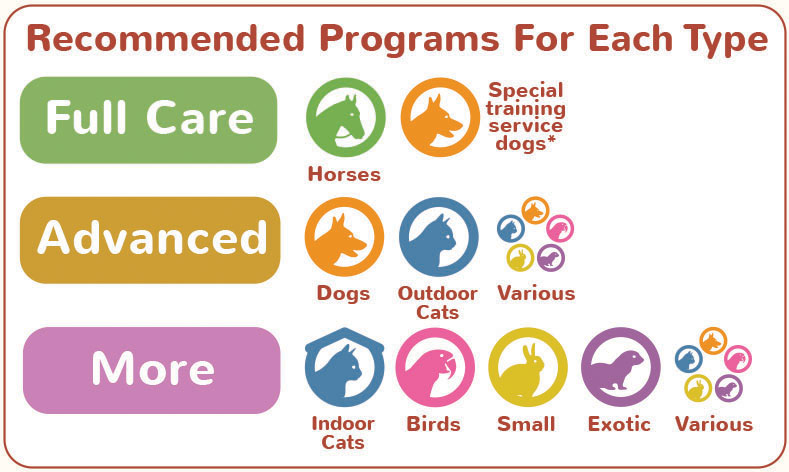
WeStopFear is the most comprehensive noise phobia therapy solution ever offered by a long shot. It offers solutions for practically all types of pets, and horses, which is a first in history. Each type has its own solution, with a dedicated list of signs of fear and phobia so the owner can monitor the process for its pet or horse.
![]()
The eight type-based programs are for dogs, outdoor cats, indoor cats, horses, pet birds, small mammals, exotic pets and households with various (i.e. more than one) types of pets.
Under small mammals fall rabbits, guinea pigs and hamsters.
Under the exotic pets solution are currently chinchilla, degu, fancy mice, fancy rats, fennec fox, ferret, gerbils, African pygmy hedgehog, sugarglider and pot-bellied pigs. It is easy, for that matter, to add types to the exotic pets section, if we get a list with description of fear signs.
The four innovations of the Simple Secure Steps™
The goal behind the innovations was to offer a process design that many users would hopefully see as easier, simpler, safer, more natural and more bearable than the classical method.
The innovations are based on carefully analyzing the classical therapy, and use methods of process analysis, process re-design and quality management to develop the new process architecture.
The Volume Anchor™ is the way of finding the right volume setting on the playback device. The setting is found by playing a piano tune. If the device has markings or numbers showing the volume, then this is needed only once for an audio device in a particular place.
The sound files that the handler plays in the streaming audio player are set to the correct volume, in the five steps of the system. This is the Ascending Loudness™ factor, where the volume is very, very low in Step 1, and then gradually higher to full volume in Step 5.
The therapy system is organized so that there is Timed Access™ to the steps, with a minimum time for each step. In the beginning, you only get access to Step 1 with sounds set very, very low. The mistake of overexposure (playing too loudly early) is practically eliminated.
In the classical therapy process, the sounds are played directly one after another. This is unnatural, as in reality a long period can pass between sounds. The Natural Intervals™ are silences of various length after each sound, which is more realistic and bearable.
Five steps, simplicity and safety
WeStopFear is a member's area with Internet streaming audio players, giving easy access to the sounds to play for your animal. You can use your mobile device or computer. You will need connected to wireless or wire-connected loudspeakers with audio quality and volume that is similar to the natural sounds when they occur.

The Simple Secure Steps feature five steps, where the sound files are pre-set to the correct volume level, which is simpler for you. Access to the steps is managed, so that you only have access to the lowest sounds in the beginning. That means there is no danger of overexposure, making this safer.

Just like you cannot learn to play a musical instrument, or become fit in the gym, and then you don't have to practice for the rest of your life, the tolerance of the animal to the sounds must be maintained. After graduating from Step 5 you enter the Maintain Success stage, which should last for all of the animal's life.
Audio tech formats
The main audio format is streaming audio, for playback devices connected through the Internet. This would be either through the Bluetooth or wi-fi to a wireless streaming device in the location, or through the mobile phone network. This is similar to streaming music from music streaming websites.
If you have an MP3 player not connected to the Internet, or a CD player, then there is an upgrade option to download MP3 audio files. You can play them, or burn your own CDs if you want.
However, note that you would have to burn at least one CD for each of the five steps. The download upgrade also includes download of the MP4 video files of the video therapy.

![]()
The download upgrade also includes download of the MP4 video files of the video therapy.

Choose your pet type or horse solution introduction:
Dogs, outdoor cats, indoor cats, horses, pet birds, small mammals, exotic pets, and households with various types of pets.
(Small mammals include rabbits, guinea pigs and hamsters. Exotic pets include chinchilla, degu, fancy mice, fancy rats, fennec fox, ferret, gerbils, hedgehog, sugarglider and pot-bellied pig. Various types of pets are any pet types combination excluding horses.)
Front Pages Links
Sounds and videos
Try the 5 steps therapy sounds players
Sounds in programs (most types)
Sounds in Solutions for Horses
Sounds in Solutions for Outdoor Cats
Explore the 5 step video therapy
The training videos
Further Information
Various information from around the web
Short comparison of WeStopFear and conventional process
What is noise phobia or fear of noises?
Conventional Noise Phobia Therapy
Comparing solutions in the market
A new standard practice for pets and horses?
The book
The book "Pets and Horses Should Not Have To Live In Fear Of Noises", written by the innovator behind WeStopFear and the Simple Secure Steps, is available on Amazon.com as Print version or Kindle version.
Chapter: About animal types, fear of sounds, and noise phobia (page 23)
Chapter: Is this new method the best method available? (page 147)
The Story: Why and how WeStopFear was developed (page 160)
About the author and developer (page 189)
Merch and designs
The merch collections and DuFauna designs are designed by the innovator behind WeStopFear and the Simple Secure Steps.
Infographics designed by WeStopFear © Copyright.