
Frequently asked questions
Is this surely a better solution?
How do I know if this is working?
What is the difference between solutions?
Do you offer personal support?
What information do I need to submit?
Can I be a user without receiving emails?
Do I need a constant Internet connection? (Wi-fi)?
Are there any reviews?
There are reviews available for previous versions of noise phobia therapy solutions by TopFauna LLC, the maker of WeStopFear. This is the website Flugeldahljod.com ("Fireworks sounds") which was a website in Iceland that featured both the classical solution and the new Simple Secure Steps therapy process design which WeStopFear features. The website became quite popular with close to 1% of households in Iceland being signed up. Users could choose which solution to try, and reviews were requested.
There are also two opinions from professionals in the US, which were requested during the development phase previously.
You can see these previous reviews here.
WeStopFear, this website, is however brand-spanking new and has not been reviewed yet. Reviews will be asked for and will be posted as soon as they arrive.
Is this surely a better solution?
The answer to this question really depends on the personal preferences of each pet owner.
There are many solutions for dogs, and at least one solution for cats and horses. There have probably not been solutions offered before for the other types of pets, i.e. pet birds, small mammals and exotic pets, although there are solutions with calming music which is not the same as noise phobia therapy.
The goal with the development of the WeStopFear is to offer process steps and general solution that have the benefits that are outlined above, i.e. to be simpler, safer, easier, more natural, more bearable, etc.
The innovations, how they work, and how they are different from previous solutions, is described, among them here and here.
I would like to see WeStopFear as the kind of innovation that electric cooking stoves and ovens were in people's kitchen, or automatic transmission in cars.
Before electric, cookers and ovens were mostly heated with coal, wood, or gas. Most people think that electric stoves and ovens are easier to use, where you only have to turn a knob, and more secure. But there are people who do want to use for instance coal or wood to cook as the standard method, for instance some restaurants.
Before automatic transmissions, the gearshift in cars was manual, where you have to step on the clutch and gas, and move the stick to shift gears. Many people think that driving a car with an automatic transmission is easier, and prefer that. Still, there are people who want to drive cars with a manual transmission. That is for instance often the case for sports cars. But they are fewer than the others, main stream car drivers.
Likewise, it may be that some prefer the conventional way in noise phobia therapy. It's a question of personal choice and that is okay. But I personally believe that the majority would prefer the new Simple Secure Steps process design, and find it easier, simpler and safer. They would thus conclude that the Simple Secure Steps process is better.
Choose your pet type solution
Is 100% success certain?
No, it is not possible to promise a 100% success. This means that out of a group of pet owners that do this, some may not be free from these problems, while others will enjoy a safe and fearless life.
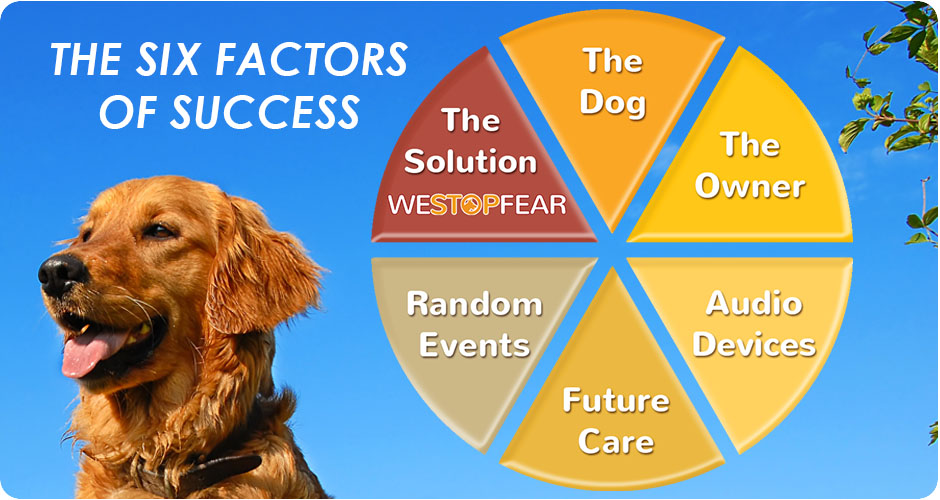
Success in this is dependent on several factors. There are six factors defined on this chart on the image below. Five of the factors are out of WeStopFear's range to manage. One of the factors is the WeStopFear solution.
The six factors of success are further explained inside the member's therapy area for each type of pet or animal.
Choose your pet type solution
How do I know if this is working?
That is a good question. To begin with, roughly around half of pets and animals may possibly have some problems with unknown, unnatural and uncomfortable noises, from mild to serious. Around 20% may have serious problems, and around 2% may suffer in the most serious and harmful way. This problem can arise at any age.
In addition, up to 80% of horses have signs of stress or more severe fear over fireworks.
This means that the other part of pets and horses will not experience problems connected with fear of noises. That would be around half of dogs and around 20% of horses.
The point is, that you never know beforehand which group your pet is in. Will it be free of these problems, or will problems develop should the animal be facing an unfavorable noise situation?
If you do noise phobia therapy, and your pet is free from these problems, is it because the therapy was working, or is it because your pet wasn't sensitive to this in the first place?
You don't know that really.
If you decide you will not do noise phobia therapy, will your pet have problems during its life? You don't know that either.
Doing noise phobia therapy to prevent a possible problem in the future, preferably from young age but also at any age, is a prudent and responsible thing to do for your pet, just like many other things that people see as being a natural thing to do.
This is in many ways similar to when you leave your home for the day, you make sure that all windows are closed, and doors are closed and locked. Should a burglar come during the day, ensuring this will reduce the likelihood of burglary. People don't generally leave all windows open and doors unlocked or even open. If someone leaves the windows open and doors unlocked, will there be burglary during that day? That is unknown. If someone has left windows open and doors unlocked, and at the end of the day the person returns and no burglar has broken in, was it okay not to lock the doors? Would it have been a mistake to lock the doors and close windows, since it turned out that no one broke into the house during that day? Few people will probably think in that way.
Doing noise phobia therapy to prevent possible problems is like locking the door to prevent the "burglar" noise fear or noise phobia to enter the "house" of your pet.
If your pet or animal has these problems, then it is imperative to do this. However, a 100% success can never be promised, because there are several things that can affect the success, and only one of them revolves around the noise phobia therapy solution itself, as is further explained in the box next above this one, "Is 100% success certain?"
Choose your pet type solution
What is the difference between solutions?
WeStopFear is offered with three programs. The user chooses which program to subscribe to and implement.
Each program offers individual solutions, where the solution is tailored for a type of pet or horses. The difference between the solutions is minimal.
Each solution offers a list of the signs of fear or phobia in that particular type of animal. The Solution for Dogs offers a list of the signs of fear or phobia in dogs. Dog owners don't need or are interested in the sings of fear in hamsters or parrots, so the Solution for Dogs pages is not cluttered with the signs in other types of pets. The Solution for Dogs also discusses dogs and has pictures of dogs, but not of other types of animals. The same goes for the solutions for the other types.
This is really the only reason why the three programs are divided into eight solutions. It is simply to create an environment where owners of different types of pets, or horses, feel is tailored for them. The basic workings and the number of sounds offered in the audio players is the same, in all the solutions of a particular program.
The eight solutions are: Dogs, horses, indoor cats, outdoor cats (because indoor cats and outdoor cats have slightly different audible environments they encounter, and thus different risk situations, so it was concluded that the prudent choice would be to offer solutions for both), pet birds, small mammals (rabbits, guinea pigs and hamsters), exotic pets (currently with list of signs of fear in 10 different types), and finally households with more than one type of pets (with lists of signs of fear and phobia in 17 different types of pets).
There are three programs offered: More, Advanced and Full Care. The difference between the programs is mainly the extensiveness of the collections of sounds, i.e. the number of different therapy sounds included in the audio players. This is based on the idea that different types of animals kept by humans don't all need the same amount of sounds to be made used to. So the programs are recommended for different types of animals.
Pets that are mainly indoors don't need very extensive training to reach sufficient level of tolerance to sounds, and thus protection against fear of sounds. The More program is tailored for them.
But if a large-breed horse spooks, prances or runs off in panic because of some sounds, with the rider in the saddle, then the human rider is in a life- or health-threatening situation. Therefore it is concluded that horses need a more extensive level of tolerance to sounds. The Full Care program is for them, with a much larger collection of sounds than the More program. Apart from that, the organization and working of the programs, the audio players, the method, are basically the same.
As was said, each program has eight different solutions for different types of pets or horses, and the solutions in a program have the same audio players, same amount of sounds.
A subscriber to a program can activate a pet type solution, and the horse solution, at the same time. So if a horse owner is in the Full Care program, and also owns a cat or a dog at home, then the horse owner can activate the cat or dog solution and implement that in the home.
There is also a horse solution in the More and Advanced programs, so a horse owner can run both the horse and pet solution there. But for horses, the Full Care program is recommended, because of the afore mentioned security reasons.
A person who owns two rabbits can subscribe to the Full Care program if that is desired, but it is not really deemed necessary.
Choose your pet type solution
Has this been researched?
Extensive research has been done throughout the years and even decades on noise phobia therapy, desensitization and habituation, to prove its effectiveness to prevent or cure these problems in pets and animals (horses for instance). This is for instance mentioned here, where it says "Desensitization and habituation methods have been widely studied (Watts, 1971; Watts, 1979 & Lader, 1968) and are proven to be effective in the management of behavioral problems in animals.".
WeStopFear is basically a noise phobia therapy, and the animal has a similar experience from WeStopFear and other conventional solutions that have been available before. The difference is in the Natural Intervals that add silences of random length between the therapy noises, to make the process more natural and more bearable, (in real life, these noises don't appear in a constant succession, one after the other, and therefore the Natural Intervals were developed to better imitate reality).
The WeStopFear solution, i.e. the structural innovations in the process design, or the steps that users need to implement to deliver the noise phobia therapy to the animal, has not been clinically tested. The innovations are mostly based on logical thinking and common sense, as is described above.
The purpose of the innovation is to create a therapy process that has the goal to be simpler, easier and safer for the human handler. What the petior horse experiences isn’t different from previous therapy process designs, (except for the silences, the Natural Intervals, after each sound described above). This means that WeStopFear should not be better nor worse than pervious solutions.
It would be interesting to have the method tested by professionals or scientists. Results from such tests will surely be posted here on the website if and when that happens.
However, here it is necessary to understand what should be tested and what not. For instance, the sound files themselves that are used here are not a fixed part of the system. If someone concludes that a sound file is not of a sufficient quality, then it is easy to remove the sound file and add another one, should a better sound file be available.
What the system is about is largely the organization and process design, how the therapy process is conducted, and how sound files with different inherent loudness or volume level are prepared and made available successively during the process, i.e. where the handler has access to very low loudness levels at the start, and has access to full loudness levels only after some time has passed, and the handler has gone through the first steps where lower loudness levels are available.
Also, the success level of doing this is based on various factors, as you can read more about in the FAQ item above "Is 100% success certain?"
Choose your pet type solution
Do you offer personal support?
Yes, the Premium upgrade includes the chance to submit personal support tickets and receive tailored answers to the Premium Program member's questions.
Apart from that, the WeStopFear solution is a self-serve solution. The extensive instructions, along with the five-step system with timed access, should be enough to guide the user to do this correctly.
Managing the process it to a large extent based on the user choosing the locations and using the best audio playback devices that the user has access to, with capable loudspeakers, and also based on the user knowing and monitoring the progress with its pets or horse. This is something that cannot really be built into the WeStopFear solution.
To maximize the likelihood that the user will do this correctly and successfully, the utmost care has been put into letting the solution be as well-developed and the instructions to be as comprehensive as possible, and there will be continuous development on that, as much as is possible regarding time and economic restraints.
If the user believes that something might be added, the user can contact WeStopFear and describe the suggested addition. If the addition is deemed to be valid and realistic, then WeStopFear will develop it and add it to the system.
Choose your pet type solution
What information do I need to submit?
WeStopFear actually requires very little information from its users.
What WeStopFear needs is only a first name or nickname of choice (to make the communiacation a bit warmer and personal), and an email address, that the member is regularly checking. We also ask for information about the user's country, (but not city or full address).
The system monitors what pet- or horse-type solution the member starts, and manages the member's access to the different steps, from Step 1 to Step 5 and onto the ongoing Maintain Success phase. This is done to ensure that the pet and horse progresses correctly through the program. This information have nothing to do with the human owner.
The paid programs are managed by our partner Clickbank, which is the world's largest, oldest and possibly most respected payment processing platform with affiliate option for digital services. The member registers on Clickbank through the sales page, and submits its information there. The only information that WeStopFear receives is that a member with a particular email address is a paying member. WeStopFear has no access to any information about billing address, or payment details.
Choose your pet type solution
Can I be a user without receiving emails?
No. WeStopFear cannot have people logged in and using the system, without WeStopFear being able to contact all our users.
Users will receive reminders and encouragement, both when using the solution for the first time and also in the future during the future and hopefully perpetual Maintain Success stage, which should preferably continue throughout the life of the pet. These maintenance reminder emails will be sent as long as WeStopFear is operational.
Along with reminders and encouragements, the emails may also contain helpful information, special offers and discount codes, so receiving the emails has great benefits too.
Choose your pet type solution
Is there an app?
The main way of managing the therapy process on a mobile device is via the web browser app, when there is a connection to the Internet. This is because the WeStopFear solution is a website.
At the moment there is not an app for the iOS (Apple) or Android operating systems available, on the Apple app store or the Google Play Store, to be installed on the user's mobile device.
That is however under consideration. The WeStopFear app would be a hybrid app (webview app), rather than a PWA (progressive web application).
Further news of a possible app will be posted when and if that materializes.
Choose your pet type solution
Is there a free trial?
There is not a free trial per-se. However, there is a 30 day money back guarantee, so you can try the solution for 30 days and get your money back if you don't want to continue. So that trial period has been free in the end if you decide that. Payments and refunds are handled by the payment service provider Clickbank. (WeStopFear has no access to your payment information).
Choose your pet type solution
Do I need a constant Internet connection?
The audio players on the member's area therapy pages are streaming players that stream the audio files over the Internet. To play those, you need to be connected to the Internet, just like when you listen to music or watch videos on social media websites.
Please note that you will be streaming the audio over the Internet, so keep in mind if you are doing that through a wi-fi or Bluetooth connection from a wireless router, or if you are streaming the audio through the G3/G4/G5 cell phone connection of your smart device. If the latter, then consider what kind of costs may ramp up when you do that. What are your data download limits? However, if you habitually watch videos on social network websites, then the audio files are considerably lighter than the average video file, so perhaps this will not be a problem.
Choose your pet type solution
Does WeStopFear utilize AI - Artificial Intelligence? (Yes, your own AI, attentive intelligence)
The therapy process is not driven by AI (Artificial Intelligence).
Instead of some AI technology being involved in the process, the users will use their own very sensitive and sophisticated AI: Attentive intelligence. They will use their attention and immediate sensitivity to secretively sense how their pet or horse is feeling, whether it is relaxed or stressed.
Utilizing AI would require that some kind of data would be collected or prepared, and fed to some AI application that would do some calculation in a large data center somewhere, and then the results from that would be sent back and should in some way manage or give recommendations about how to manage the process.
This data would either be arranged by the human handler, who would have to be quite occupied doing that, or there would be some kind of technology monitoring the pet or horse constantly to assess the situation of the pet or horse, and the loudness of the sound. Some one would suggest that this should be the smart phone of the owner. But the smart phone would have to have the pet or horse within its field of vision which may not be easy at all, except if the owner is busy doing that.
This could be in contradiction with the basic requirements of the therapy process, which is that the sounds should be heard like a coincidence, and there should be no action or reaction from the human handler that would give the pet or horse a reason to figure out that there is something unusual going on. The human handler should not react, neither to the sounds nor to the pet or horse.
What about other methods, like medications, drugs, CBD oils, DAP/CAP, flower remedies, storm wraps, etc.
The Simple Secure Steps noise phobia therapy solution of WeStopFear is about exposing pets and horses to various sounds in a gradual systematic manner, to build up familiarity with, and indifference and fearlessness of various sounds.
They experience that they are not in danger of any kind when they hear them, which turns the sounds into "white noise" that does not matter.
If that is a success, then the pet or horse will not be stressed or scared of said sounds, just like we humans are not stressed by the sounds.
The problem is solved.
There are many other solutions which are advocated to deal with the problem of fear of sounds. This included anti-anxiety medications, anti-depressants, various other drugs and medications, CBD oils which are substances made from the cannabis plant, flower remedies which are substances extracted from various plants and flowers usually dissolved in alcohol and given in microdoses, DAP (dog appeasing pheromones) and CAP (cat appeasing pheromones), storm wraps for dogs to deal with fear of fireworks and thunder, and the like. Obviously, those are offered for sale and those selling them or promoting them have a vested interest in someone buying them, to generate revenue and profits.
If the pet or horse has gotten used to the sounds, and is just indifferent and not alarmed in any way by said sounds, then the need to give the pet or horse any kind of substances to deal with fear or anxiousness is completely unnecessary.
The developer of WeStopFear believes that to be the healthiest choice, and should be attempted first, before giving the pet or horse drugs, medications, cannabinoids, etc.
However, it is quite possible that conducting noise phobia therapy, either for prevention or treatment, will not be enough. In that case, additional remedies may be advisable.
WeStopFear neither recommends the usage of these medications, oils, drops, etc., nor talks against the usage of these. They may or may not be advisable (although those who sell or promote such solutions as affiliates usually don’t hesitate to argue for them, as if the usage of those is always a no brainer and no other options discussed).
The decision of giving or not giving these medications should be solely in the domain of veterinarians who are asked for advice by the pet or horse owners.
Choose your pet type or horse solution introduction:








Dogs, outdoor cats, indoor cats, horses, pet birds, small mammals, exotic pets, and households with various types of pets.
(Small mammals include rabbits, guinea pigs and hamsters. Exotic pets include chinchilla, degu, fancy mice, fancy rats, fennec fox, ferret, gerbils, hedgehog, sugarglider and pot-bellied pig. Various types of pets are any pet types combination excluding horses.)
Front Pages Links
Start program:
Types Solutions
Overview
Videos
Introduction videos (short & long)
Explore the 5 step video therapy
Sounds overviews
Try the 5 steps therapy sounds players
Sounds in programs (most types)
Sounds in Solutions for Horses
Sounds in Solutions for Outdoor Cats
Further Information
What is noise phobia or fear of noises?
Conventional Noise Phobia Therapy
Short comparison of WeStopFear and conventional process
Comparing solutions in the market
A new standard practice for pets and horses?
The book
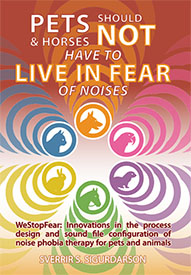
The book "Pets and Horses Should Not Have To Live In Fear Of Noises", written by the innovator behind WeStopFear.
Buy print version on Amazon.com
Buy Kindle ebook version.
Read free chapters from the book: Click here to tell us where to send it to.
Merch and designs
The merch collections and DuFauna designs are designed by the innovator behind WeStopFear.

Stock images from 123rf.com, model release contract, (referral link). - Infographics designed by WeStopFear © Copyright.